

Enhanced Hydrogen Production from Ammonia using Advanced Catalysts Anchored on Ceramic 3D Printed Lattices and Microbeads
Hydrogen is one of the most promising clean energy carriers of the future. It produces no harmful gaseous emissions during use and has a very high heating value of approximately 120 MJ/kg, nearly three times higher than that of gasoline. However, its widespread application is limited by challenges related to storage and transportation, as hydrogen must be stored either as a cryogenic liquid or under very high pressure. In addition, its low volumetric energy density and hydrogen embrittlement of metallic materials increase the complexity and cost of hydrogen infrastructure.
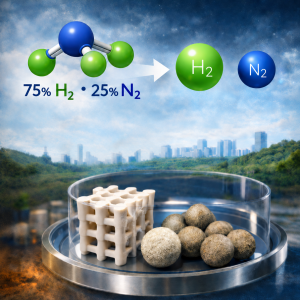
Ammonia (NH₃) offers an attractive alternative as a hydrogen carrier. It has a high hydrogen content (17.8 wt.%), a volumetric energy density of 4.3 kWh/L, can be stored as a liquid under relatively mild conditions, and benefits from an already established global production, storage, and transportation infrastructure. To recover hydrogen, ammonia must be efficiently decomposed into hydrogen and nitrogen using highly active catalysts.
The HydroProCera project addresses this challenge by developing a new generation of high-entropy oxide (HEO) catalysts supported on porous ceramic microbeads and 3D-printed ceramic lattice structures for efficient, low-energy hydrogen production from ammonia without CO₂ emissions. The project combines innovative catalyst materials with advanced ceramic supports to improve catalyst activity, stability, and overall process efficiency. In the long term, the developed technology has the potential to support the widespread adoption of hydrogen as a clean energy carrier, contributing to global decarbonization, increased energy security, and the transition towards a sustainable energy economy. Moreover, successful implementation of the project results may strengthen the competitiveness of European hydrogen technologies, stimulate innovation within the renewable energy sector, and create new opportunities for industrial development and high-skilled employment.
The ceramic supports will be fabricated using Drop Casting and Direct Ink Writing (DIW) methods, enabling precise control of geometry and porosity. Compared with conventional supports, these structures might provide improved heat and mass transfer, enhanced mechanical stability, and reduced consumption of expensive catalytic materials.
To achieve these objectives, brings together expertise in catalyst synthesis, advanced ceramics, additive manufacturing, materials characterisation, numerical modelling, and catalytic testing. The developed catalytic systems will be evaluated under laboratory and bigger scale conditions to demonstrate their potential for industrial implementation. The main activities include:
Project results can be implemented, further developed, or exploited in collaboration with the following target groups:
“HydroProCera: Enhanced Hydrogen Production from Ammonia using Advanced Catalysts Anchored on Ceramic 3D Printed Lattices and microbeads” (SPPW/HydroProCera/0078/2024-00) was supported by the Swiss Contribution to reducing economic and social disparities in the EU and from the state budget through the National Centre for Research and Development, within the Research and Innovation Programme, Applied Research of The Swiss-Polish Cooperation Programme, SPPW Call 2024.
Total project cost: 4 542 010 PLN
Total project funding: 4 477 750 PLN
Agreement signing date: 29 October 2025